- Memory Health
- Health
- Brain Health
- Education
- by The Memory Exam Team
- March 24, 2025
If the idea of reading nutrition labels, counting grams of sugar, or tracking omega-3 intake feels overwhelming, there’s good news: You don’t have to. What if there was a simple way to eat that naturally supports your brain without all the number crunching?
Enter the MIND Diet - a powerful, research-backed approach that blends the Mediterranean and DASH diets to create a sustainable way of eating for better brain health.
What is the MIND Diet?
MIND stands for Mediterranean-DASH Intervention for Neurodegenerative Delay. Developed by researchers at Rush University Medical Center, the MIND diet focuses on whole foods and minimizes processed ingredients in a way that is easy to follow.
In a long-term observational study of older adults in Chicago, those whose eating most closely matched the MIND pattern developed Alzheimer’s disease at a rate 53% lower than those whose eating matched it least. Moderate adherence was associated with a rate about 35% lower. (Morris MC, Tangney CC, Wang Y, et al. MIND diet associated with reduced incidence of Alzheimer’s disease. Alzheimer’s & Dementia 2015;11(9):1007-1014.)
those figures describe an association rather than a proven effect. The study recorded what people already ate instead of assigning them a diet, so it cannot separate the food from everything else that tends to accompany it.
A randomised trial published later put the question directly. Older adults with a family history of dementia were assigned either the MIND diet or a mildly calorie-restricted control diet for three years. Cognitive and brain-imaging outcomes did not differ significantly between the two groups, and both groups improved slightly. (Barnes LL, Dhana K, Liu X, et al. Trial of the MIND Diet for Prevention of Cognitive Decline in Older Persons. New England Journal of Medicine 2023;389:602-611.)
the honest summary is that the MIND diet is a sensible way to eat that has not been shown to outperform other sensible ways of eating. That is a reason to adopt it comfortably rather than anxiously.
The beauty of the MIND diet is that it isn’t about restriction or perfection-it’s about gradually shifting toward brain-supportive foods.
The MIND Diet Food Groups
Here’s how the MIND diet breaks down, with a focus on simplicity rather than labels:
10 Foods to Eat More Often
these are the foods you should regularly include in your meals:
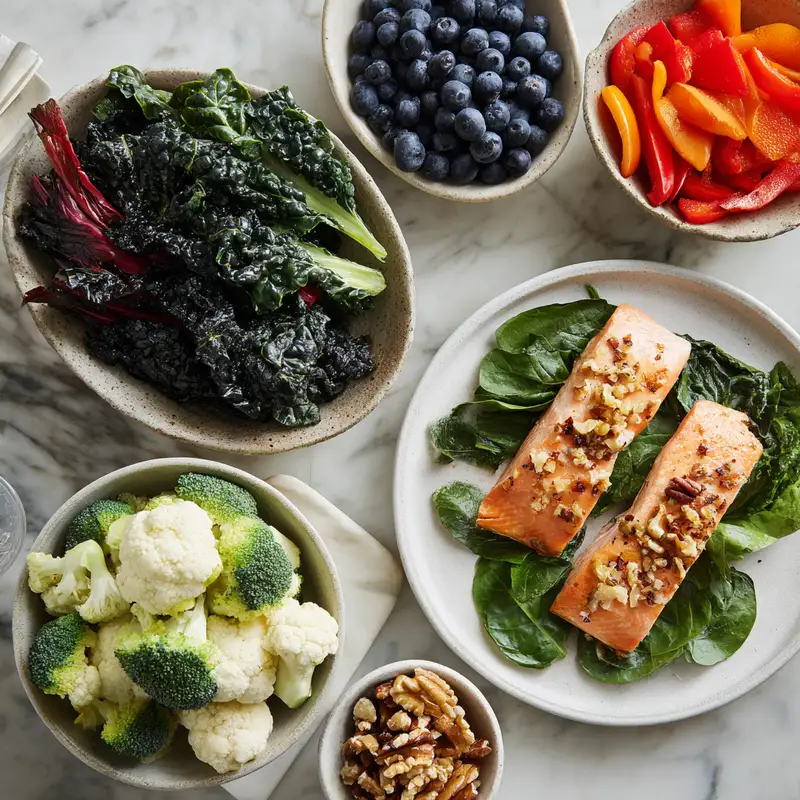
- Green Leafy Vegetables - Think spinach, kale, Swiss chard. Aim for at least one serving per day.
- Other Vegetables - Broccoli, carrots, peppers, cauliflower. One or more servings daily helps keep your brain nourished.
- Berries - Blueberries and strawberries are especially beneficial. Two or more servings per week is ideal.
- Nuts - Walnuts, almonds, pistachios. A small handful most days can support memory.
- Olive Oil - Use it as your main cooking oil or in salad dressings.
- Whole Grains - Oats, brown rice, quinoa, or whole grain bread. Three servings per day.
- Fish - Especially fatty fish like salmon or sardines. At least once a week.
- Beans - Lentils, black beans, chickpeas. Include them in meals three times a week or more.
- Poultry - Chicken or turkey. Eat twice or more per week.
- Wine - In moderation (no more than one glass a day), wine-especially red-may provide antioxidant benefits. Skip it if you don’t drink.
5 Foods to Minimize (But Not Obsess Over)
you don’t need to eliminate these completely-just enjoy them less frequently:
- Red Meat - Limit to fewer than four servings per week.
- Butter & Margarine - Use sparingly; aim for less than one tablespoon per day.
- Cheese - Limit intake to once per week or less.
- Pastries & Sweets - Occasional treats are fine, but try to avoid daily consumption.
- Fried or Fast Food - Reduce to less than once per week.
No Label Reading Required
Unlike many diets that rely on tracking calories or decoding ingredient lists, the MIND diet emphasizes whole foods that are easy to recognize. If your meal includes colorful vegetables, a healthy fat like olive oil, a source of protein (like beans, fish, or poultry), and whole grains-you’re doing it right.
While label reading isn’t required for this diet, numerous MIND cookbooks are available for those who prefer following recipes.
A typical brain-healthy day on the MIND diet might look like this:
- Breakfast: Oatmeal with berries and a sprinkle of walnuts
- Lunch: Lentil soup with a whole-grain roll and a leafy green salad dressed in olive oil
- Snack: A handful of almonds and carrot sticks
- Dinner: Grilled salmon, steamed broccoli, and quinoa
Why It Works
the MIND diet works because it supports brain health on multiple fronts:
- Reduces inflammation
- Supports blood vessel health
- Provides essential brain-building nutrients like folate, vitamin E, and omega-3s
- Encourages antioxidant-rich foods that protect against cellular damage
Unlike extreme diets, the MIND diet allows for flexibility. It’s not about what you can’t eat-it’s about what you eat most of the time.
Final Thoughts
if you’re looking for a brain-friendly way to eat that doesn’t involve weighing portions or dissecting ingredient lists, the MIND diet is one of the most sustainable and science-supported strategies available. Even partial adherence can offer cognitive benefits.
Together, these habits create a feedback loop that supports mental clarity, emotional balance, and long-term cognitive resilience.
If you’re looking to stay sharp, sleep well. Your brain will thank you in the morning-and for many years to come.
The message is clear: Feed your brain whole, vibrant foods and it will thank you for years to come.
Related Posts

Sleep’s Crucial Role in Memory Protection
Protecting your memory as you age - Part 3
After exploring how dietary habits impact memory …
Omega-3 Fatty Acids: Nature’s Brain Boosters
Protecting your memory as you age - Part 2
Fortunately, not all dietary choices pose risks-s…

The Sugar-Memory Connection: What Science Reveals
Protecting your memory as you age - Part 1
Have you ever walked into a room and forgotten wh…